
Step Aerobics: Benefits, Beginner Workout and Safety Tips

What Is Step Aerobics?
Step aerobics combines rhythmic cardiovascular exercise with repeated step-ups on a raised platform, typically four to twelve inches high. By stepping up and down in different patterns, you can elevate your heart rate, challenge your lower-body muscles, and work on coordination at the same time.
One of the advantages of step aerobics is its versatility. Moves can range from simple step-ups and step-downs to more advanced sequences involving lateral movement and changes of direction, and the platform height, pace, and choreography can all be adjusted to suit different fitness levels. That makes it a practical way to improve aerobic fitness, challenge the lower body, and add more moderate- or vigorous-intensity activity to your week.
Whether you're new to step aerobics or a more experienced exerciser, the emphasis should be on controlled movement, good foot placement, and gradual progression.
Benefits of Step Aerobics
Like other forms of regular physical activity, step aerobics can support heart health, metabolic health, mood, and long-term weight management.
Supports Cardiovascular Health
Aerobic exercise raises your heart rate and increases the demand on your cardiovascular system. With regular training, the heart and circulatory system become more efficient at delivering oxygen-rich blood throughout the body.
Regular aerobic activity can help improve cardiovascular fitness, lower blood pressure, and contribute to a healthier cholesterol profile. Over time, being physically active is also associated with a lower risk of cardiovascular disease and stroke. Improved aerobic fitness can also make everyday activities, such as climbing stairs, walking longer distances, or carrying groceries, feel easier.
Supports Weight Management
Step aerobics can raise your heart rate and increase energy expenditure during a workout. When performed regularly alongside an overall healthy eating pattern, aerobic exercise can contribute to long-term weight management and improvements in body composition.
Supports Mood and Brain Health
Aerobic exercise can reduce feelings of anxiety and is associated with benefits for mood and brain health. Some small studies of step aerobics have reported favorable short-term mood and anxiety responses, although a 2026 systematic review found that the step-specific evidence remains too limited to draw firm conclusions about psychological benefits.
A step class can also provide a social and engaging way to accumulate regular physical activity. Regular physical activity more broadly is associated with benefits for thinking, learning, and memory, particularly as we age.
Builds Muscular Endurance and Functional Fitness
Step aerobics primarily challenges the legs and glutes while your core helps stabilize the body. Repeated stepping can improve muscular endurance and functional fitness, although dedicated resistance training remains important for building and maintaining muscle.
In a 12-week study of elderly women, step aerobics training led to measurable improvements across several functional-fitness measures, such as strength, flexibility, and mobility (Hallage et al., 2010). Findings like these suggest step aerobics may be a useful tool for maintaining independence and function with age, though individual results vary and more research is needed across broader populations.
Supports Blood Sugar Control and Metabolic Health
Regular physical activity can improve insulin sensitivity and help with blood sugar control. Staying physically active is also associated with a lower risk of developing type 2 diabetes and metabolic syndrome. These benefits are another reason to combine regular aerobic activity with strength training and an overall healthy lifestyle.
Supports Bone Health and Balance
Weight-bearing exercise such as step aerobics can also play a role in bone and balance health, although the effects depend on factors such as program length, intensity, and the population being studied.
In an exploratory randomized study of community-dwelling older women, an eight-week step aerobics program improved some measures of balance, including mobility and postural control, while general health perception also improved relative to the control group (Dunsky et al., 2017).
Separately, a 10-week step aerobics program in postmenopausal women with low bone mass improved functional fitness and produced favorable changes in a marker of bone resorption, although it did not significantly change bone mineral density over the relatively short study period (Wen et al., 2017).
Longer-term and appropriately prescribed weight-bearing exercise may be needed to meaningfully influence bone density, particularly in people with low bone mass or osteoporosis.
Is Step Aerobics Low Impact?
Step aerobics can provide a relatively low-impact cardiovascular workout when movements stay controlled and jumping or running-style variations are avoided. That said, intensity and impact rise as step height, pace, and choreography complexity increase. Beginners should start with a low platform and simple stepping patterns before progressing to faster, higher-impact, or more complex movements.
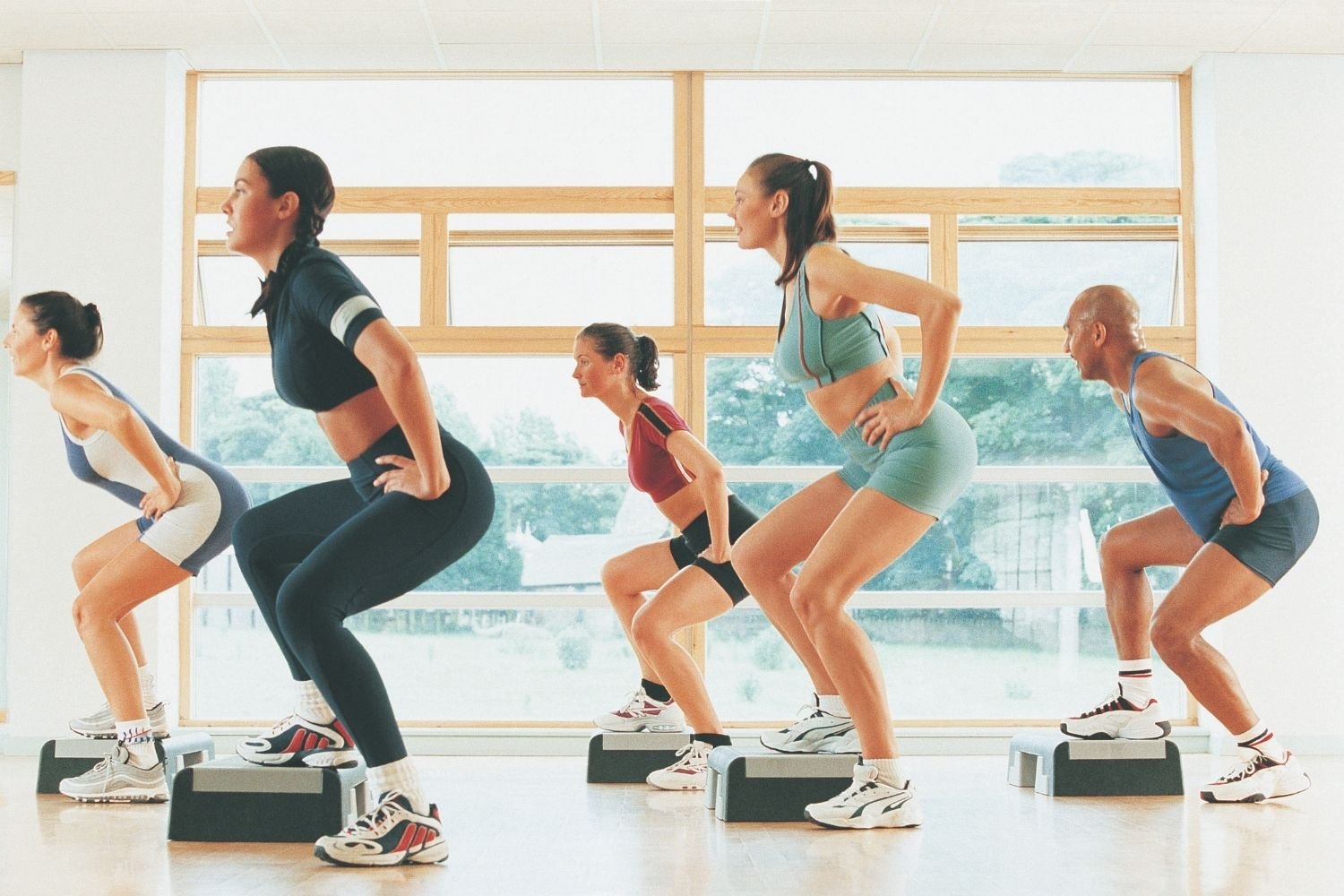
Step aerobics has been a group-fitness staple for decades and can be adapted to different fitness levels by changing the step height, pace, and choreography.
Beginner Step Aerobics Workout
This 15-minute routine (5-minute warm-up, 5-minute stepping routine, 5-minute cool-down) is designed for beginners. Start with a low platform and focus on controlled movement rather than speed. The goal is to learn the stepping patterns, raise your heart rate gradually, and build confidence before increasing pace, step height, or complexity.
Warm Up: 5 Minutes
Begin with easy movement on the floor before stepping onto the platform.
March in place at a comfortable pace.
Add gentle arm swings as you warm up.
Progress to side steps or step touches.
Gradually increase your pace until your breathing and heart rate begin to rise.
You should feel warm and ready to move, but not tired.
Beginner Step Routine: 5 Minutes
Perform each movement for about one minute. Move at a pace that allows you to stay in control throughout.
1. Basic Step
Step onto the platform with your right foot, followed by your left. Step back down with the right foot, then the left. Continue for 30 seconds, then switch your lead foot. Keep your whole foot on the platform and avoid letting your heel hang over the edge.
2. Alternating Knee Lift
Step onto the platform with one foot and lift the opposite knee toward your chest. Step back down and repeat on the other side. Keep your chest lifted and use your arms naturally for balance.
3. Side Step
Stand beside the platform and step up sideways with the foot closest to the step. Bring the other foot up, then step back down under control. Change sides halfway through the minute. Keep your knees aligned with your toes and avoid twisting as you step.
4. Alternating Leg Curl
Step onto the platform with one foot and gently bend the opposite knee, bringing your heel toward your glutes. Step back down and alternate sides. Keep the movement smooth rather than trying to kick the heel as high as possible.
5. Easy Basic Step
Return to the basic step for the final minute and gradually reduce your pace. Use this portion to bring your breathing down before moving into your cool-down.
Cool Down: 5 Minutes
Step off the platform and continue moving gently rather than stopping abruptly.
Walk or march slowly in place.
Allow your heart rate and breathing to return gradually toward normal.
Finish with gentle stretches for your calves, quadriceps, hamstrings, and hips if they feel comfortable.
Beginner Step Aerobics Tips
Start with a low, stable platform and supportive athletic shoes. Place your entire foot on the step, step down softly, and keep your movements controlled. Avoid jumping, running-style movements, or complicated choreography until you're comfortable with the basic patterns. As your coordination and fitness improve, you can gradually increase the duration, pace, or height of the platform.
If five minutes of stepping feels challenging at first, begin with a shorter interval and build up gradually. Step aerobics can contribute toward your weekly aerobic activity, but it's also worth combining cardio with regular strength training for a balanced fitness program.
Safety note: Stop exercising if you experience chest pain, severe shortness of breath, dizziness, or unusual pain. If you have a medical condition, significant joint problems, balance difficulties, or are returning to exercise after an injury or long break, consider speaking with a qualified healthcare or fitness professional before starting.
The Takeaway
Step aerobics is an adaptable way to build cardiovascular fitness, challenge your lower body, and add more moderate- or vigorous-intensity activity to your week. Start small with the beginner routine above, focus on controlled form over speed, and let the pace, height, and choreography grow with your confidence.
References
Centers for Disease Control and Prevention (CDC). Health Benefits of Physical Activity for Adults. cdc.gov.
U.S. Department of Health and Human Services. Physical Activity Guidelines for Americans, 2nd edition (2018). Current recommendation: 150–300 minutes of moderate-intensity aerobic activity weekly, or 75–150 minutes of vigorous-intensity activity, plus muscle-strengthening activity on two or more days per week.
Hallage, T., Krause, M. P., Haile, L., Miculis, C. P., Nagle, E. F., Reis, R. S., & Da Silva, S. G. (2010). The effects of 12 weeks of step aerobics training on functional fitness of elderly women. Journal of Strength and Conditioning Research, 24(8), 2261–2266.
Dunsky, A., et al. (2017). The use of step aerobics and the stability ball to improve balance and quality of life in community-dwelling older adults: A randomized exploratory study. Archives of Gerontology and Geriatrics.
Gao, X., Li, C., Silang, R., Zhou, W., & Shu, Y. (2026). Effects of structured step-aerobics interventions on psychological well-being in nonclinical populations: A systematic review. Frontiers in Psychology, 17, 1843115. pubmed.ncbi.nlm.nih.gov/42317698
Wen, H. J., et al. (2017). Effects of short-term step aerobics exercise on bone metabolism and functional fitness in postmenopausal women with low bone mass. Osteoporosis International.
Read Next
Keep Building Your Fitness
Continue with practical, evidence-informed guides to cardio, strength, and sustainable training.
How to Return to Exercise After Time Away
Restart safely, rebuild consistency, and progress without trying to make up for lost time.
The 6-6-6 Walking Routine
Explore another beginner-friendly way to build aerobic activity into your week.
What Matters Most for Lifelong Fitness
See how cardio, strength, mobility, recovery, and consistency fit together over the long term.